Modern jazz time again. This record is not that rare (it has been reissued on CD), but at the same time, it's not particularly easy to find in any format.
Howard McGhee (1918-1987) was born in Tulsa and raised in Detroit. Although he was not as famous as, say, Dizzy Gillespie, Charlie Parker, or Fats Navarro, he was, like them, an important figure in the transition to modern jazz. McGhee wrote "McGhee Special" for the Andy Kirk big band, and recorded it with Kirk in 1942. His own version, from three years later, is even more exciting and daring than the Kirk side. It's an outstanding virtuoso trumpet performance, as well as a lesson in the extended harmonies the modernists were exploring at the time.
The flip side, "McGhee Jumps," is a more basic blues tune, but with a few modern touches, and with good solos by (I think) Vic Dickenson on trombone and Teddy Edwards on tenor sax in addition to McGhee. This was also issued as "Cool Fantasy, part 1." The full personnel of McGhee's smallish big band is:
McGhee, Snooky Young, Karl George - trumpets
Vic Dickenson, Gene Roland - trombones
Robert Isabell, Gene Porter - alto saxes; Teddy Edwards, James King - tenor saxes
Vernon Biddle - piano; Bob Kesterson - bass; Roy Porter - drums.
The Bihari brothers, Joe, Saul, and Jules, started the Modern label in Los Angeles in 1945. The story of the label and its subsidiaries is a long and fascinating one - too long to get into here - but many great jazz and blues recordings first appeared on the Bihari's labels.
My copy of this record is in generally excellent condition, but there is a little swishing at the beginning of each side. Enjoy "McGhee Special" and "McGhee Jumps," recorded in Hollywood in September, 1945.
McGhee Special
McGhee Jumps
Saturday, October 18, 2014
Friday, September 12, 2014
Comparing Stokowski - Acoustic and Electric
Leopold Stokowski was one of those artists, like his contemporary, Duke Ellington, who understood the
recording studio early on. Most musicians in the early days of the record business were pretty much at the mercy of the recording engineers in terns of how their recordings sounded, but Stokowski and Ellington knew what they wanted the finished products to sound like, and knew how to achieve those results. At evey stage of his recording career, Stokowski was a pioneer. He rearranged the Philadelphia Orchestra on stage and in the studio for better balance (and later for better stereo separation). When electric recording became standard, he used the mixing board as well as the baton to achieve the dynamics he wanted from his musicians.
Stokowski's early acoustic recordings with the Philadelphia Orchestra represent the state of the art of the period, but he wasn't satisfied with them - and no wonder. The acoustic recording process could only
capture a fragment of the timbral and dynamic richness of an orchestra, and he was forced to use a reduced version of the orchestra, since the acoustic recording horn couldn't handle a full symphony orchestra. Stokowski really came into his own in the studio with the advent of the microphone. Recording on the stage of the Philadelphia Academy of Music with the full orchestra, his early electric recordings were revelatory at the time, and still sound impressive today.
Here are two Stokowski/Philadelphia recordings of the same piece, "March of the Caucasian Chief" by Mikhail Ippolitov-Ivanov. The earlier version was made at Victor's Camden, New Jersey studio on April 29, 1922. The second recording was cut in Philadelphia on October 11, 1927. It's an interesting contrast, and reveals much about the differences between the acoustic and electric recording processes.
March of the Caucasian Chief, 1922
March of the Caucasian Chief, 1927
recording studio early on. Most musicians in the early days of the record business were pretty much at the mercy of the recording engineers in terns of how their recordings sounded, but Stokowski and Ellington knew what they wanted the finished products to sound like, and knew how to achieve those results. At evey stage of his recording career, Stokowski was a pioneer. He rearranged the Philadelphia Orchestra on stage and in the studio for better balance (and later for better stereo separation). When electric recording became standard, he used the mixing board as well as the baton to achieve the dynamics he wanted from his musicians.
Stokowski's early acoustic recordings with the Philadelphia Orchestra represent the state of the art of the period, but he wasn't satisfied with them - and no wonder. The acoustic recording process could only
capture a fragment of the timbral and dynamic richness of an orchestra, and he was forced to use a reduced version of the orchestra, since the acoustic recording horn couldn't handle a full symphony orchestra. Stokowski really came into his own in the studio with the advent of the microphone. Recording on the stage of the Philadelphia Academy of Music with the full orchestra, his early electric recordings were revelatory at the time, and still sound impressive today.
Here are two Stokowski/Philadelphia recordings of the same piece, "March of the Caucasian Chief" by Mikhail Ippolitov-Ivanov. The earlier version was made at Victor's Camden, New Jersey studio on April 29, 1922. The second recording was cut in Philadelphia on October 11, 1927. It's an interesting contrast, and reveals much about the differences between the acoustic and electric recording processes.
March of the Caucasian Chief, 1922
March of the Caucasian Chief, 1927
Monday, August 25, 2014
Kryl and Haines from 1903
I found myself listening to a bunch of records from the first five years of the 20th century today, and decided to share one. The public's taste at this time, as least as the record companies read it, leaned toward novelty songs, marches, and what the British still call "light music." It was only with the onset of Caruso's recording career that music of any profundity began to be recorded.
But there is a certain charm in many of those early-20th-century records. I've chosen one because it's a typical brass showpiece record of the time, and because it's in remarkably excellent condition. Most of my records from this period are pretty worn, but I would guess that my copy of Oxford 1189 had never seldom played before I took it home from an antique store in Woodstock, Georgia.
Oxford was the second label used by the Sears, Roebuck & Co. chain of department stores. Their first label was Harvard; their most well-known and longest-running label was Silvertone. But between those two labels, from 1907 to 1915, they used the name Oxford on their records. The first Oxfords were pressed for Sears by Victor, using material from Victor's Zonophone subsidiary, but they soon turned to Columbia to provide their records. Oxfords were single-sided, and featured a confusingly-worded legal notice on their reverse sides; many labels used a similar notice at the time.
Oxford 1189 was pressed around 1908 from a master made for Columbia in early 1903: "Birds of the Forest." There is no composer credit on the label, but a little research reveals that this "Polka de Concert" is Sebastian Mayr's opus 75, and that it was a brand-new composition at the time of this recording. There is no artist credit, either, but the performers are the flamboyant Czech cornet virtuoso Bohumir Kryl and his frequent musical partner Leroy Haines on trombone. Kryl was a businessman and art collector in addition to being a soloist and bandleader; he was a well-known and much-recorded figure in the first few decades of the 20th century.
Enjoy this very nice recording of "Birds of the Forest" by Kryl and Haines.
Birds of the Forest
But there is a certain charm in many of those early-20th-century records. I've chosen one because it's a typical brass showpiece record of the time, and because it's in remarkably excellent condition. Most of my records from this period are pretty worn, but I would guess that my copy of Oxford 1189 had never seldom played before I took it home from an antique store in Woodstock, Georgia.
Oxford was the second label used by the Sears, Roebuck & Co. chain of department stores. Their first label was Harvard; their most well-known and longest-running label was Silvertone. But between those two labels, from 1907 to 1915, they used the name Oxford on their records. The first Oxfords were pressed for Sears by Victor, using material from Victor's Zonophone subsidiary, but they soon turned to Columbia to provide their records. Oxfords were single-sided, and featured a confusingly-worded legal notice on their reverse sides; many labels used a similar notice at the time.Oxford 1189 was pressed around 1908 from a master made for Columbia in early 1903: "Birds of the Forest." There is no composer credit on the label, but a little research reveals that this "Polka de Concert" is Sebastian Mayr's opus 75, and that it was a brand-new composition at the time of this recording. There is no artist credit, either, but the performers are the flamboyant Czech cornet virtuoso Bohumir Kryl and his frequent musical partner Leroy Haines on trombone. Kryl was a businessman and art collector in addition to being a soloist and bandleader; he was a well-known and much-recorded figure in the first few decades of the 20th century.
Enjoy this very nice recording of "Birds of the Forest" by Kryl and Haines.
Birds of the Forest
Friday, August 1, 2014
Unreissued American Music, part 1
Composer, violinist, percussionist, writer, and jazz historian Bill Russell started the American Music label in 1944 to issue the recordings he made of the traditional jazz musicians of New Orleans. Between that year and 1953, Russell issued 40 78s (including seven 12-inchers) and 13 10" LPs of the music he recorded. After that, the label was more or less dormant for years, although Russell would occasionally license some of the material for issue in Japan or Europe.
Eventually, the American Music catalog was bought by the Jazzology group, and Russell lived to oversee the first few AM CD reissues. By now the CD series has expanded to the extent that almost all of Russell's American Music recordings are available on CD, including many alternate takes and previously unissued items. But for a variety of reasons, there are a few of the original 78s that were never reissued on LP or CD. I'll present them all here, starting with one side of AM 535, "Eh, La-Bas!" by the Original Creole Stompers.
The Stompers consisted of Herb Morand on trumpet, Louis Nelson on trombone, the searing clarinet of Albert Burbank, veteran guitarist Johnny St. Cyr, Austin Young on bass, and Albert Jiles on drums. They were recorded by Russell at Burbank's home on Lapeyrouse Street in New Orleans on the evening of July 13, 1949. Russell issued two 78s from the session; eventually almost the entire session was issued on CD, including four tunes from a rehearsal session the night before. Barry Martyn, who produced the CD, opted to use the rehearsal take of "Eh, La-Bas!" instead of the originally issued take. That rehearsal take has its own charm - it's slower, more relaxed, and two minutes longer than the 78 take. But Burbank's clarinet is seemingly on fire on the originally-issued take, and it's a shame to let this fine music languish unheard. So here's one side of American Music 535, featuring the clarinet and Creole vocal of Albert Burbank.
Eh, La Bas!
Eventually, the American Music catalog was bought by the Jazzology group, and Russell lived to oversee the first few AM CD reissues. By now the CD series has expanded to the extent that almost all of Russell's American Music recordings are available on CD, including many alternate takes and previously unissued items. But for a variety of reasons, there are a few of the original 78s that were never reissued on LP or CD. I'll present them all here, starting with one side of AM 535, "Eh, La-Bas!" by the Original Creole Stompers.
The Stompers consisted of Herb Morand on trumpet, Louis Nelson on trombone, the searing clarinet of Albert Burbank, veteran guitarist Johnny St. Cyr, Austin Young on bass, and Albert Jiles on drums. They were recorded by Russell at Burbank's home on Lapeyrouse Street in New Orleans on the evening of July 13, 1949. Russell issued two 78s from the session; eventually almost the entire session was issued on CD, including four tunes from a rehearsal session the night before. Barry Martyn, who produced the CD, opted to use the rehearsal take of "Eh, La-Bas!" instead of the originally issued take. That rehearsal take has its own charm - it's slower, more relaxed, and two minutes longer than the 78 take. But Burbank's clarinet is seemingly on fire on the originally-issued take, and it's a shame to let this fine music languish unheard. So here's one side of American Music 535, featuring the clarinet and Creole vocal of Albert Burbank.
Eh, La Bas!
Thursday, July 17, 2014
Arnold Földesy on Odeon
Here is a record by the brilliant, eccentric Hungarian cellist Arnold Földesy, on the American Odeon label. Földesy, a student of the influential cellist David Popper, played with the Berlin Philharmonic, and in 1924 began a solo career that lasted until his retirement in 1933. Fellow cellist Gregor Piatigorsky described him: "Unreliable and exuberant, and not
very scholarly, he had a peasant-like directness, and his mastery of his
instrument attracted me." Piatigorsky goes on to relate a visit to Földesy during which the latter practiced naked while his wife massaged his head.
The Odeon label had branches across the globe. The history of American Odeon is confusing and convoluted. The label was used by Okeh for "ethnic" recordings, and later for classical recordings made in Europe, like this one. Okeh, and Columbia, who bought American Odeon along with Okeh, used a variety of label styles and colors. Information about the 3000 series of imported recordings is hard to come by; my best guess about this record is that it dates from the middle of the 1920s. In any case, Odeons were well-made records, and these two sides by a fine cellist hold up well. Here is Földesy playing Chopin's "Nocturne in E Flat," Op. 9. No. 2, and "Serenade (Zur Guitarre)" by his teacher, David Popper.
Nocturne in E Flat
Serenade
The Odeon label had branches across the globe. The history of American Odeon is confusing and convoluted. The label was used by Okeh for "ethnic" recordings, and later for classical recordings made in Europe, like this one. Okeh, and Columbia, who bought American Odeon along with Okeh, used a variety of label styles and colors. Information about the 3000 series of imported recordings is hard to come by; my best guess about this record is that it dates from the middle of the 1920s. In any case, Odeons were well-made records, and these two sides by a fine cellist hold up well. Here is Földesy playing Chopin's "Nocturne in E Flat," Op. 9. No. 2, and "Serenade (Zur Guitarre)" by his teacher, David Popper.
Nocturne in E Flat
Serenade
Monday, June 9, 2014
Jean Moeremans
I'm keeping this post in place as a chronological placeholder, but it has been supplanted by this post.
Friday, May 23, 2014
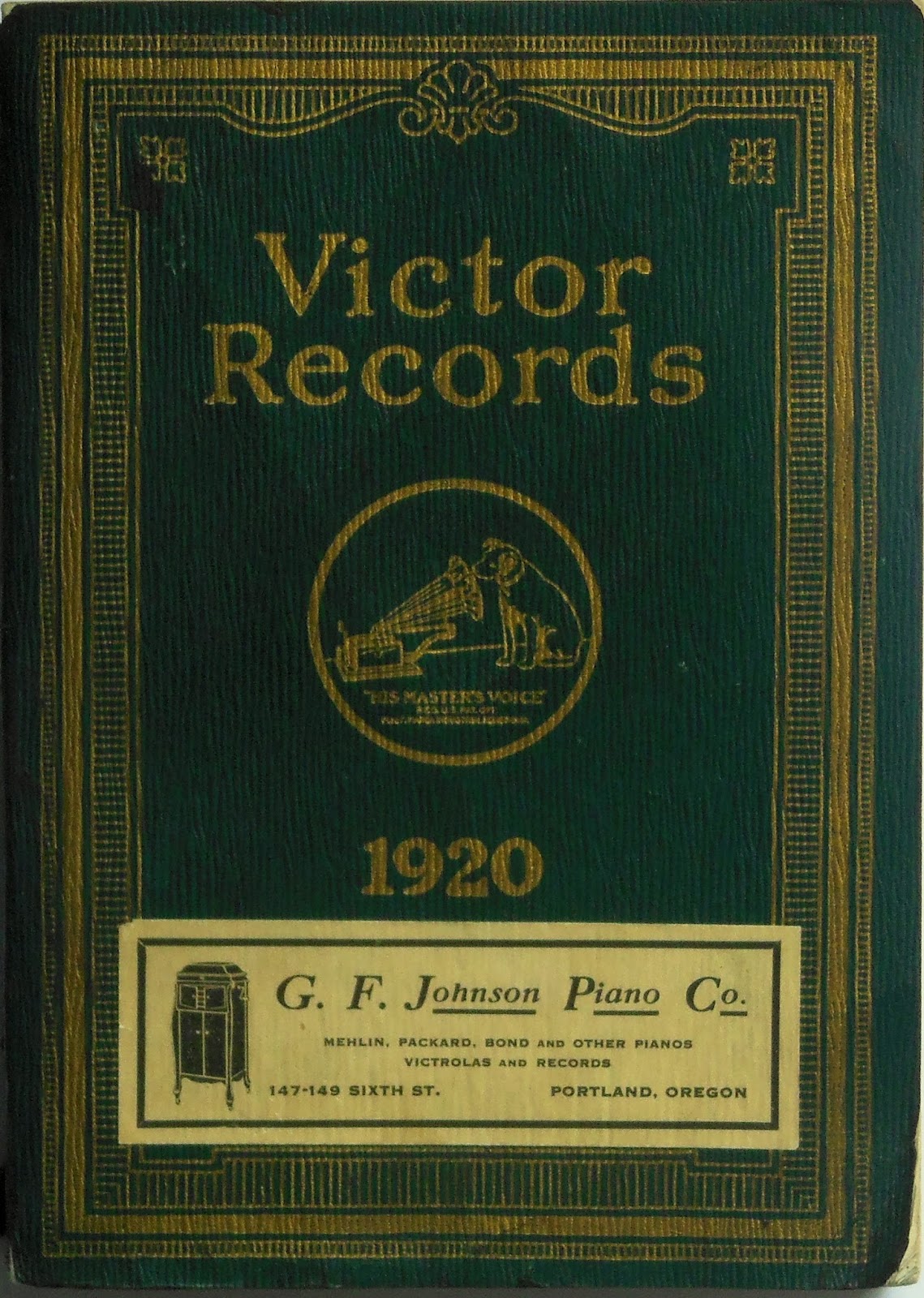
1920 Victor Catalog
Here are some pictures of Victor's complete catalog for 1920. The major labels issued annual catalogs like this, which were supplemented by monthly booklets listing new releases. (Check out the Vocalion monthly supplement reproduced in full in my March 30, 2014 post.) This is a thick book; the pages aren't numbered, but I would guess that it's at least 300 pages long. The paper is thin, but tough; Victor designed this catalog to stand up to a lot of use, and it's still in pretty good shape 94 years later.
I love thumbing through these old record catalogs - seeing what's in print, finding records I have, and getting a feel for musical tastes of the time. Of course, I'm particularly interested in listings for records and styles of music that I like.
By 1920, changing tastes meant that the 1913-1914 recordings of James Reese Europe's Society Orchestra, once the standard for African-American dance/popular music, were out of print. But there was an exciting new style of music called jazz - so new, at least as far as the
record-buying public knew, that there only nine jazz records listed. And they were given their own special listing; when I looked for the Original Dixieland Jazz Band, the catalog directed me to "See 'Jazz Band.'" If it looks like more than nine records were listed, look again - each side is listed separately.
The Victor label represented "class," and they were extremely proud of their Red Seal records. This was their classical line, with an emphasis on opera. At this time Red Seals were more expensive than Victor's regular black-label records, and were still only one-sided. The Victor catalogs of this period all had a special section near the back, printed on pink paper, with the Red Seal listings. This section is more elaborate that the rest of the catalog, with pictures and biographies (sometimes somewhat fanciful) of the artists. Victor didn't get the full benefit of its contract with Enrico Caruso, which "does not expire until 1933," since Caruso himself unfortunately expired the next year.
And thanks to other insane 78 collectors on the web, I now know where the G.F. Johnson Piano Co. was in Portland. They were the Victor Records dealer who distributed this copy of the 1920 catalog, as shown by the sticker on the cover. It looks like there's a nice little park with an interesting sculpture there now.
I love thumbing through these old record catalogs - seeing what's in print, finding records I have, and getting a feel for musical tastes of the time. Of course, I'm particularly interested in listings for records and styles of music that I like.
By 1920, changing tastes meant that the 1913-1914 recordings of James Reese Europe's Society Orchestra, once the standard for African-American dance/popular music, were out of print. But there was an exciting new style of music called jazz - so new, at least as far as the
record-buying public knew, that there only nine jazz records listed. And they were given their own special listing; when I looked for the Original Dixieland Jazz Band, the catalog directed me to "See 'Jazz Band.'" If it looks like more than nine records were listed, look again - each side is listed separately.The Victor label represented "class," and they were extremely proud of their Red Seal records. This was their classical line, with an emphasis on opera. At this time Red Seals were more expensive than Victor's regular black-label records, and were still only one-sided. The Victor catalogs of this period all had a special section near the back, printed on pink paper, with the Red Seal listings. This section is more elaborate that the rest of the catalog, with pictures and biographies (sometimes somewhat fanciful) of the artists. Victor didn't get the full benefit of its contract with Enrico Caruso, which "does not expire until 1933," since Caruso himself unfortunately expired the next year.
And thanks to other insane 78 collectors on the web, I now know where the G.F. Johnson Piano Co. was in Portland. They were the Victor Records dealer who distributed this copy of the 1920 catalog, as shown by the sticker on the cover. It looks like there's a nice little park with an interesting sculpture there now.
Subscribe to:
Posts (Atom)